Only 3 in 10 Latin Americans have reached a real level of financial inclusion. And those who already have access to products, for the most part, don’t know how to use them. What happens in the space between having and understanding?
RELEVANT DATA
In Latin America, we live with a contradiction we rarely name clearly: we have built an impressive financial infrastructure — digital, accessible, growing — but half of the region’s adults still face real barriers to access. And among those who already have access, most don’t know how to use what they have to improve their lives.
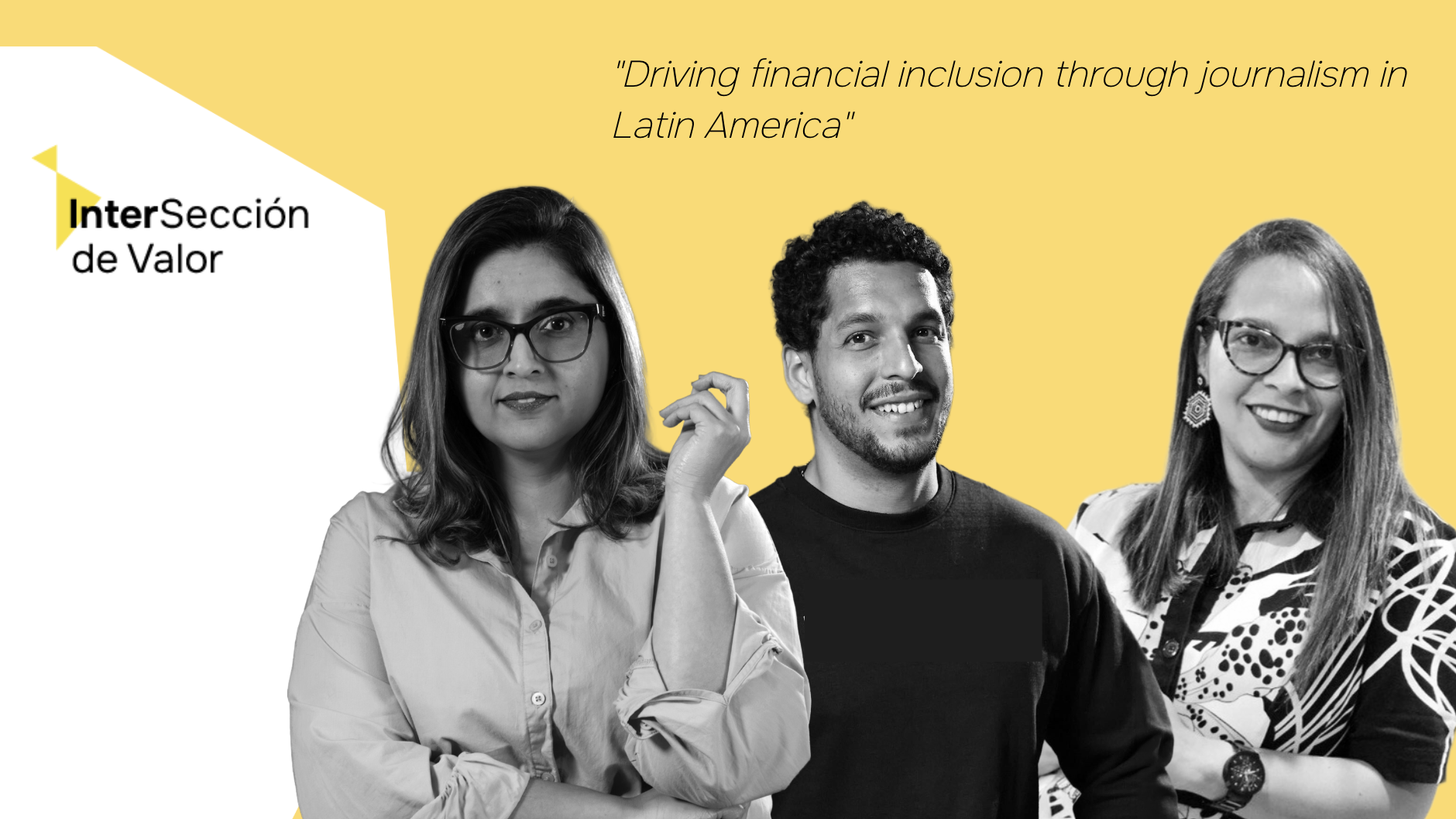
That was the starting point of the webinar «Driving Financial Inclusion Through Journalism in Latin America», organized by LatAm Intersect as part of our series Intersección de Valor. An initiative covered by media outlets such as Portal dos Jornalistas and Revista Salto. For the session, we brought together three voices: Olga Rendón, creator of Salva Tu Bolsillo; Katyanny Ramírez, director at Finsus; and Javier Bastardo, Forbes columnist and PR manager at Bitfinex for Latin America.
Before the webinar, we surveyed more than 100 journalists across Latin America. The results were revealing: 45.5% consider financial inclusion topics very relevant for their audience. But at the same time, 63.6% acknowledged needing more training and resources to cover these topics with greater depth. High relevance, insufficient tools: that tension summarizes the state of financial journalism in the region today.
The data that says it all
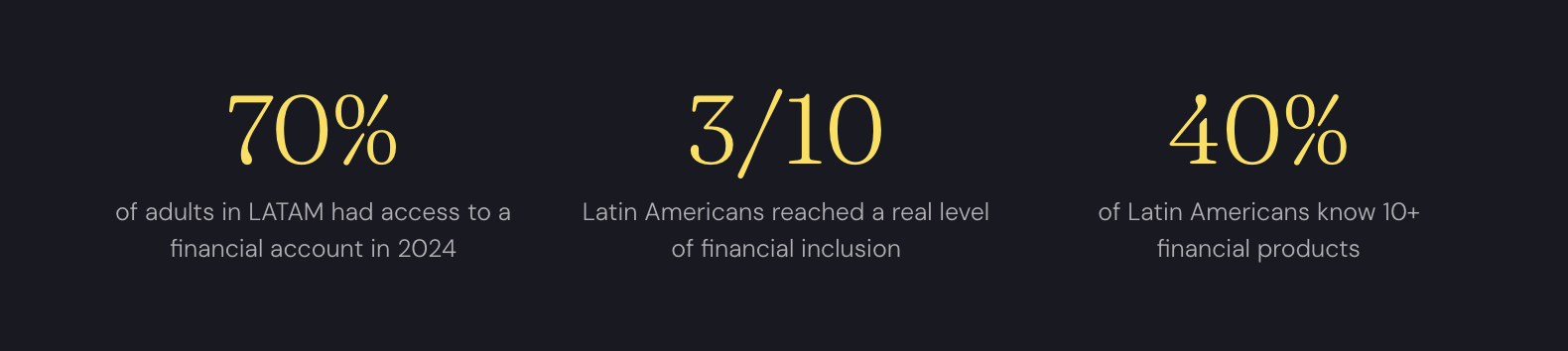
According to the Global Findex 2025, 70% of adults in Latin America had access to a financial account in 2024; however, access does not equal effective use: according to the fifth edition of Credicorp’s Financial Inclusion Index (IIF 2025), only 30% of Latin Americans reached the highest level of financial inclusion, 41% are in progress, and 29% remain at a low level. Barely 3 in 10 people actually take advantage of the financial system they theoretically have access to. A gap documented by La República and Portafolio.
In terms of product knowledge, only 40% of Latin Americans know ten or more financial products, an improvement of 18 percentage points since 2021, but one that exposes a gap that access numbers don’t capture.
The region shows a heterogeneous map. The Southern Cone, led by Chile and Argentina, leads in financial inclusion. Central America presents a divided picture: Costa Rica and Panama at the forefront, and the northern triangle, Guatemala, Honduras, and El Salvador, still lagging behind. Cash dependency remains high, and in many markets, advances in digital infrastructure have not been accompanied by the cultural changes needed to take advantage of it.
Having a bank account or a digital wallet does not equal financial health. The paradox is that access without education can generate new forms of vulnerability: over-indebtedness, fraud, or simply idle money that doesn’t work for anyone.
The barriers that access doesn’t eliminate
Journalist Olga Rendón, former editor of El Mundo and El Colombiano, and creator of the personal finance platform Salva Tu Bolsillo, was direct: labor informality, fear of the tax system, and distrust of cybersecurity remain critical barriers preventing citizens from using financial services to transform their quality of life.
“Informality, fear of the tax system and distrust of cybersecurity remain critical barriers preventing citizens from using financial services to improve their quality of life.”
A financial system that generates distrust is not an accessible system, no matter how many products it offers. And this is where communication enters as a strategic variable, not a decorative one.
The role of journalism: more than reporting, translating
Katyanny Ramírez, sustainability and financial inclusion specialist, director at Finsus, and founder of Co-Crear Consultoría, raised something that resonated throughout the conversation: without a clear and accessible narrative, technological access does not translate into real well-being. The media doesn’t just report on the financial system, it makes it intelligible or incomprehensible to millions of people.
“A high percentage of population lives without real control of their finances, reflecting a financial health problem that goes beyond mere access”
This perspective puts on the table something that communications agencies and public relations teams in financial entities should internalize: the problem is not always about the product, but about the message.
DeFi and crypto: the new chapter of inclusion
Javier Bastardo, philosopher, Forbes columnist, and public relations manager for Bitfinex in Latin America, expanded the debate toward decentralized finance. Latin America is one of the world’s fastest-growing regions for cryptocurrency adoption, and Chainalysis data confirms it: between July 2022 and June 2025, the region recorded nearly $1.5 billion in crypto transaction volume, a transformation that Cointelegraph and iProUP have also covered extensively.
“Decentralized finance (DeFi) has not only proven to be a useful alternative to address complex and high-impact phenomena in the region such as inflation – for example through stablecoint remittances – but has also allowed individuals and companies to raise capital through the tokenization of real word assets (RWA), which, in addition to connecting with traditional finance (capital markets), enables the economic development markets.”
However, Bastardo was emphatic: ignorance about companies in the sector remains a huge obstacle. More technological access without more financial education reproduces, in a different format, the same old problem.
The conclusion that matters for companies
The three experts agreed on the same closing thesis: the success of financial inclusion in Latin America will not be measured by the number of accounts opened, but by people’s real capacity to make informed financial decisions.
For companies in the sector, this has a direct implication: communication is not a marketing expense — it is an investment in education that yields returns in trust, adoption, and customer retention.
Transparency and simplicity of message are not editorial virtues. They are the most powerful tools for converting technological access into sustainable prosperity. As America Retail aptly summarizes: the great challenge is no longer opening accounts, but teaching people how to use them.
Does your brand communicate clearly in LATAM?
Let’s talk about how a well-designed communication strategy can turn access into trust, and trust into growth. talk.to.us@latamintersectpr.com
FAQ
How many Latin Americans have access to a financial account?
According to the Global Findex 2025, 70% of adults in Latin America had access to a financial account in 2024. However, only 30% reach a real level of financial inclusion according to the IIF Credicorp 2025.
Why doesn’t access to financial products guarantee real financial inclusion?
Only 40% of Latin Americans know ten or more financial products. Having an account does not equal knowing how to use it to improve financial well-being.
What are the main barriers to financial inclusion in LATAM?
The main barriers are labor informality, fear of the tax system, and distrust of cybersecurity, according to journalist Olga Rendón.
How are DeFi and cryptocurrencies being used for financial inclusion in LATAM?
Decentralized finance is used as an alternative to the traditional financial system, especially in high-inflation contexts. Chainalysis reports nearly $1.5 billion in crypto transaction volume in the region between 2022 and 2025.
What role does journalism play in financial education in Latin America?
Journalism serves a translation function for complex concepts. A LatAm Intersect survey of more than 100 journalists revealed that 63.6% need more training to cover these topics with depth.
How can a company in the financial sector improve its communication in LATAM?
The problem is not always about the product, but about the message. Brands that communicate with simplicity and transparency generate more trust and adoption. An effective strategy must consider cultural differences, local media ecosystems, and the level of financial education of each audience.