Climate models and field experiments highlight ways to reduce environmental and economic losses in the Amazon
Text by Anderson Araújo. Reviewed by Carla Fischer.
Translated by Diego Lopes/Verso Tradutores
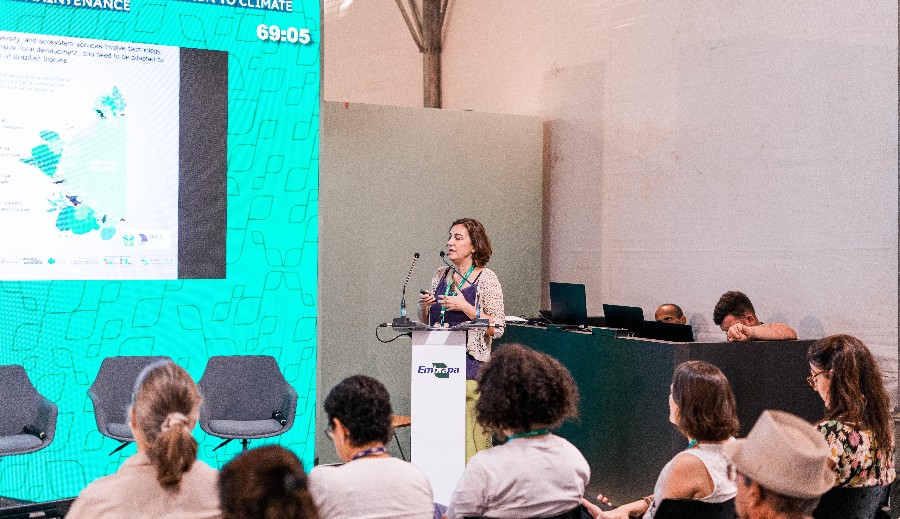
Oxford University researcher Aline Soterroni uses mathematical models to predict scenarios for the Amazon and warns that, if nothing is done, Brazil could lose more than 60 million hectares to deforestation in the coming decades. This data is part of environmental scenario modeling studies presented by her during the panel “How to reconcile Agriculture, Biodiversity and Ecosystem Services,” at the AgriZone of COP 30, this Thursday (November 20).
Soterroni explained that so-called baseline scenarios, which simulate the future while maintaining the current logic of production, point to the risk of continued deforestation. In addition to the loss of species and climate balance, this process also increases greenhouse gas emissions, making deforestation one of the country’s main sources of emissions.
The second level of risk presented in the models shown by Aline concerns the combined impacts of deforestation and climate change. According to the researcher, climate scenarios indicate that regions currently seen as promising for agricultural expansion may become less productive.
Despite the warning, the scientist highlighted that the scenarios also point to more optimistic alternatives, provided effective public policies are implemented. In strong governance scenarios, which include deforestation control and territorial management, the gains can be significant.
One of the studies cited by Soterroni shows that, in the transition region between the Amazon and the Cerrado, protecting the territory could prevent losses of up to $1 billion per year in agricultural damage. “When deforestation is controlled and the forest is protected, the models show that it is possible to avoid significant economic and productive losses,” she stated.
The researcher explained that scenario modeling uses mathematical systems capable of simulating the interaction between land use, climate, species, and economic dynamics. The idea is to transform environmental data into projections that can guide governments and decision-makers.
At the end of the presentation, the researcher turned to a reflection inspired by Indigenous Peoples. Citing the shaman Davi Kopenawa and the Indigenous leader Ailton Krenak, Soterroni stated that science can be a bridge between two worlds.
“The forest Peoples already know that without the forest there is no water, no food, no life. But, to speak to the ‘people of merchandise,’ we need models and scenarios. I like to say that I use mathematics as an ally of the forest to show the value of the standing forest,” she concluded.
Conservation and family farming
The panel also featured the experience coordinated by researcher Joice Ferreira, from Embrapa Amazônia Oriental, who presented projects on environmental conservation and family farming in the Amazon, focusing on the empowerment of traditional Peoples and socio-biodiversity. One of the highlights was RefloraMais, an initiative created in 2017 through cooperation between Brazil and France. The initiative has consolidated itself as an action-research group and inspired the creation of the Capoeira Center, dedicated to the socio-environmental restoration of the forest.
According to the researcher, the project’s principle is that of a socially just environmental restoration, incorporating the knowledge of family farmers, Indigenous communities, and quilombola communities. She warned that about 90% of land use in the Amazon is already occupied by pastures, which puts pressure on agrobiodiversity and disrupts traditional ways of life. The proposal, according to her, is to strengthen traditional family farming as a pillar of conservation and as the basis of what is called “good living”.
Joice Ferreira also presented the structure of the Capoeira Center, which brings together more than 100 researchers from over 30 institutions and operates through living laboratories in strategic regions such as Santarém, northeastern Pará, and the Gurupi region. These spaces function as environments for the co-construction of knowledge, where scientific research and traditional knowledge meet.
Cerrado
Researcher Fabiana Aquino, from Embrapa Cerrados, presented to the panel experiences carried out in the Brazilian Cerrado to reconcile agricultural production and environmental conservation, defending the concept of compensation for environmental services, such as soil conservation, increased water infiltration, carbon sequestration, and maintenance of biodiversity.
These services are being recognized through Payment for Environmental Services programs, such as the one developed in the Federal District’s watershed, covering approximately 1,500 hectares. In the region, rural producers receive economic incentives for adopting good practices that include environmental conservation. The results lead to greater water retention in the soil, reduced erosion, and a strengthened hydrological activity in the watershed.
Between 2013 and 2022, the program signed 210 contracts, involving about a third of the producers in the area, with investments exceeding R$ 3 million. The average payment is around US$60 per hectare per year, a value considered low by the participants, who nevertheless emphasize that the main incentive is the contribution to water and soil conservation, essential for the sustainability of agricultural production itself.
The experience in the Cerrado, according to the researcher, shows that it is possible to transform conservation into a concrete economic opportunity for farmers, combining productivity, environmental resilience, and income generation in the countryside.
Strategic role of INPA
The director of the National Institute for Amazonian Research (INPA), Henrique dos Santos Pereira, presented projects focused on the recovery of degraded areas through forest and agroforestry systems. These studies combine nanotechnology, biotechnology, and genetic improvement, with the Brazil nut as the initial initiative. The initiative involves cooperation networks in all Amazonian states, satellite monitoring and the Internet of Things, as well as tests for the inclusion of these systems in future carbon credit markets.
According to the director, INPA’s importance for research on ecosystem services lies precisely in its ability to integrate cutting-edge science, researcher training, and the practical application of knowledge. With 3,200 master’s and PhD graduates, the institute is consolidating itself as a key player in transforming forest conservation into real opportunities for sustainable development in the region.
Based in Manaus and operating throughout the Amazon region, INPA is today one of the leading scientific references in tropical biology, ecology and ecosystem studies, in addition to playing a decisive role in the training of researchers and in the consolidation of public policies aimed at sustainability.
The panel was moderated by Raquel Prado, a researcher at Embrapa, who presented the basis of the thematic report “Agriculture, Biodiversity and Ecosystem Services,” prepared within the scope of the Brazilian Platform on Biodiversity and Ecosystem Services. The document is the result of more than three years of work and the collaboration of about one hundred researchers from different biomes in the country. The report does not consist of original research, but rather a broad synthesis of scientific knowledge, bringing together data and successful experiences on how to reconcile agricultural production, biodiversity conservation, and the maintenance of ecosystem services.
This report was produced by Amazônia Vox, through the Collaborative Socio-environmental Coverage of COP 30. Read the original report at https://www.amazoniavox.com/noticias/view/550/pesquisadoras_alertam_sobre_acoes_urgentes_para_frear_desmatamento_e_reforco_da_restauracao_na_amazonia